A story from Between Restless Jews and Weary Arabs
She had to come back, even if she didn't
She looked sad and started crying. I could hardly hear her stifled, almost inaudible, and hushed sniffing. What else could she do? Every adventure must have an end. She was aware of everything she had done. That we had done. She put everything in the suitcase. As I was shocked, she said:
"I'll come back."
Suspended between reality and delusion, I wanted to hope and said:
"Give me the address of your parents in Privas. We never know!"
She gave me the address, and I wrote it down on a piece of paper I haven't been able to find since.
I looked at her as she combed her hair in front of the mirror in the old wardrobe. Then, after adjusting her clothes, she approached me and pressed my head against her hot body. She did not say anything. Then she sat beside me and wrapped her arms around me. I understood everything, but I didn't want to. What could I understand? She had to come back, even if she didn't. I could not do anything. It must have happened.
"I'll be back."
Mr. Mercier was right. I accompanied her to Perrache railway station. On the platform, I felt I was kissing her for the last time.
"I'm waiting for you tomorrow! Do you understand? I will wait for you!"
Then, finding my composure again, I continued:
"Above all, do not travel at night! Write me! Call me! Do not forget to call me!"
I followed her to the train carriage. She walked stoically despite her mournful face. Then she got on the train and passed through the compartments. I shadowed her along the railway track. She stopped in front of a closed window. I stopped below. She stuck her face on the frame. I saw her tears running down her face and onto the glass. My lips twitched as the train left. Her sweet face disappeared along the interlocking rails, the wagons, and the tangled wire web of the poles.
I returned to the hotel without strength, my head emptier than ever. I lay down on the bed and stared at the walls. Dark and painful images passed before my eyes.
I saw the glassy eyes of a bloodstained bull again, staggering on the sand, in a bullfight corrida organized in the sports city of Beirut. My older brother had taken me there. At that time, I hoped from the bottom of my heart that the bull would gore the picador who speared it deeply, and the matador who tormented it, in front of a crowd cheering in delirium.
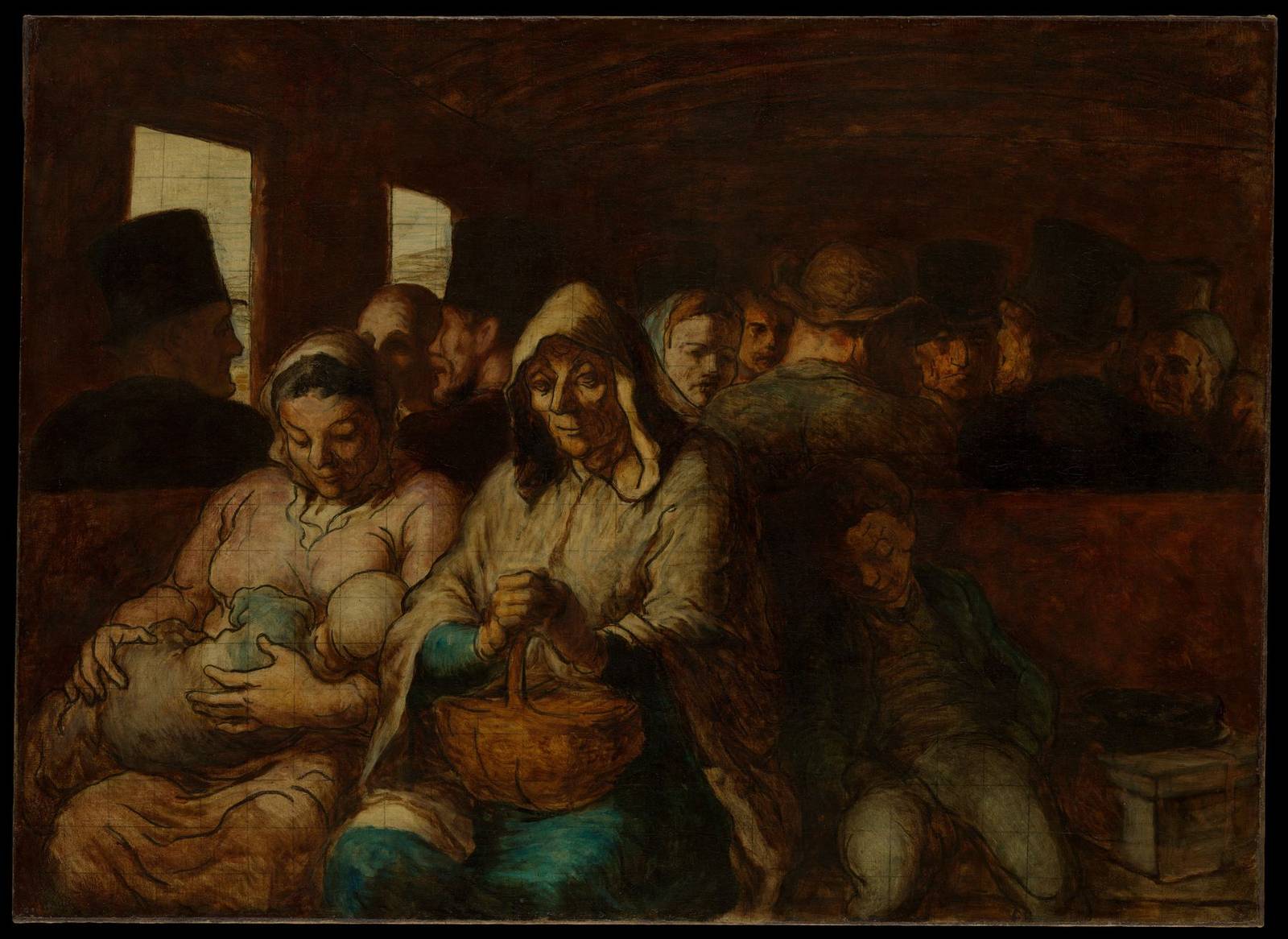
Background: Honoré Daumier, “The Third-Class Carriage”, 1864. The Metropolitan Museum of Art (public domain)