A story from Between Restless Jews and Weary Arabs
An obligatory woman
I toured Yemen in 2005. It is a stunning country, one of the most beautiful I have ever visited. Rugged mountains high up, on which medieval villages perch, blending magically with their environment and difficult to reach.
As we walked through a village called Al Mahweet, I saw a Yemeni woman, cloaked in a black veil, carrying a heavy jug of water on her head. At the same time, a 35-year-old man leant against a stretch of wall. I approached the latter, who had a ‘Janbiya’ (dagger) in a sheath fixed to a wide leather belt worn around his lower abdomen. He was armed with an assault rifle, like many Yemenis. As the guide would not let me speak to him, our driver asked the man if I could ask him two questions. To my surprise, the man said:
"You 'Nousrani' (Christian), come forward and ask me whatever you want!"
I felt unsettled when I was called ‘Nousrani’ (The Quran calls Christians ‘Nasara.’ It could be derived from followers of Jesus of Nazareth). I found out later that foreigners who do not wear traditional Yemeni clothes are assumed to be Christians. As the woman passed us, I asked him, "Wouldn't it be a kind act if a man carried this heavy jug instead of the woman?"
"Carrying jugs of water is good for women. It straightens their bodies up!"
"What if the woman refuses to carry the jug?"
"Be assured that in all of Yemen, not a single woman can say no to a man."
His radical response, along with Yemen's mysteries and silences, baffled me. A flurry of brusque airflow brushed my hair and penetrated my ears. Oh, blowing wind, what are you going to tell me that I have not already heard or seen?
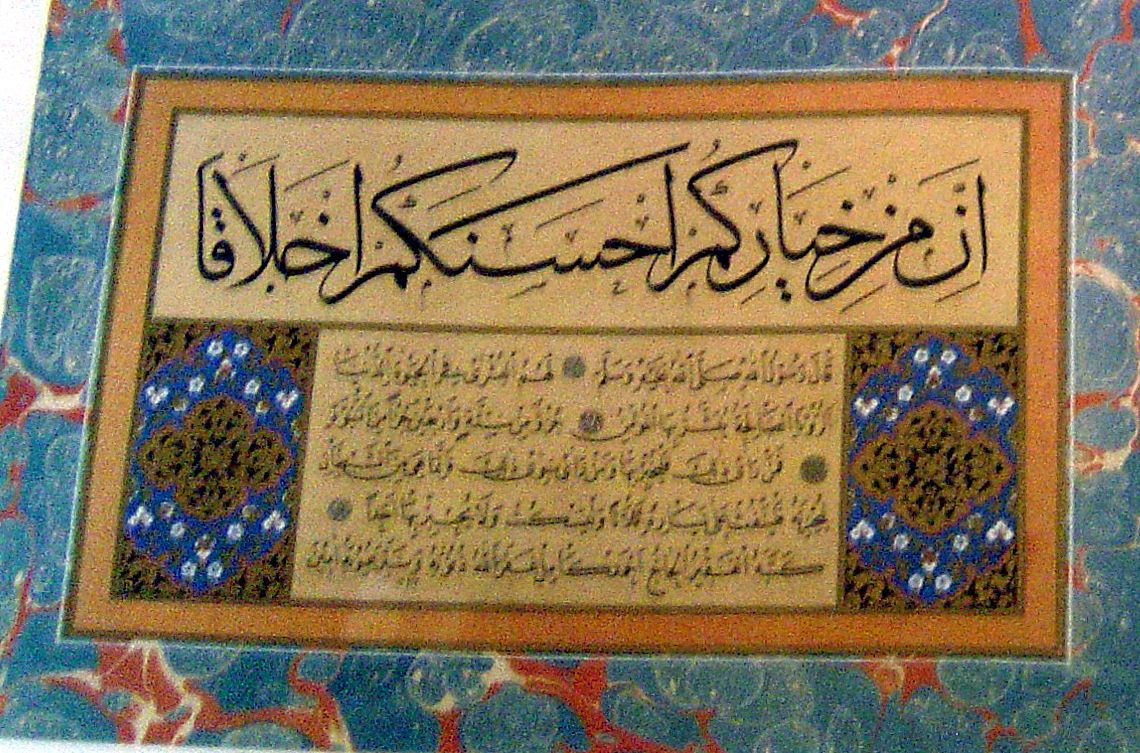
Background: إن من خياركم أحسنكم أخلاقا · The best among you are those with the finest character. Ottoman calligraphy, from an album published in Turkey in 1912