A story from Between Restless Jews and Weary Arabs
A gap of almost five decades
When we arrived at St Jérôme, the little rain that had fallen while we drove had stopped. The road and the grass on the sides were still wet. The first thing I noticed was that the new ‘Nationale’ does not go through the village as it did in 1967. It bypasses it, adding to its solitude and desolation.
We entered the village from the north by the old road, or what used to be called ‘Nationale 74.’ I recognized Hotel Villiers; it was closed. The old house where I used to live was still there. I saw the closed window of my old room at street level. Everything was still and dusky. No trace of a living thing in this small, remote village at the start of the cold season.
While we moved slowly, I showed Juliane the corner of the house and its yard, where the old ground-floor apartment of Liesel and Lucien was supposed to be. There were no cars in the earthen yard. After we had driven down the old road and reached the new ‘Nationale’ at the southern end of the village, I asked Juliane to turn back. Then, at my suggestion, she parked her Renault against a fence topped with loose barbed wire, 100 meters away from the old house.
As I cautiously stepped out, trying not to hit the car door against the barrier, a growling dog in the enclosure lunged at me. I stepped back inside the car, my heart pounding. A bad omen! Juliane restarted the robust Clio and parked further away against the high wall of another house. The atmosphere was unnerving. Yet Juliane looked just as willful and keen to know as much as I did.
Earlier, before reaching St Jérôme, we had agreed that she would drive slowly through the village and that I would look around without drawing any attention. This would help our quest. We would continue our drive to the end of the village. We would stop there and discuss the best way to handle the matter.
As we had not seen anyone, Juliane suggested checking the occupant's name on the door of Liesel's old apartment first. She would knock at the door and ask when the nearby Villiers Hotel would open, acting as if she had stayed there a few years before. If she found out that Liesel or Lucien still lived there, this would be the end of my journey, as a firm decision must have been made to end our relationship, most probably because Lucien had discovered it. If a new occupant were there, she thought that, in the ensuing conversation, she would ask about Liesel, pretending she had met her at the hotel.
I had already told Juliane that Liesel had once mentioned that Lucien had bought a new house in the village, but I never asked whether they lived in it. We hoped different occupants lived in the old building. But I remained skeptical.
Juliane headed for the old ground-floor apartment with sure steps. I walked hesitantly in the other direction, thus avoiding the enclosure where the dog jumped on the fence. I was scared and numbed by a faraway past which had revived itself in my mind.
After a few minutes, Juliane came back to tell me she couldn't read the nameplate and that, when she used her cell phone to shine light on it, she found the ink had faded due to rain and rust. She knocked at the door. Nobody answered.
"At this time of the year, I doubt whether any outsider lives in the village. The villagers who stay here sleep and wake up early. I know from St Fleury."
Before heading for Serres, I asked Juliane to stop again in front of the hotel. I stepped down and looked at it again. It looked much smaller than it had before. "How our perceptions of things change over time! A gap of almost five decades. Does objective reality exist?" I wondered.
Then, on our way to Serres in the South, I thought of the dreadful night when Liesel and I were caught. I walked on the road where everybody gathered on that summer night of 1967, pointing their fingers at us.
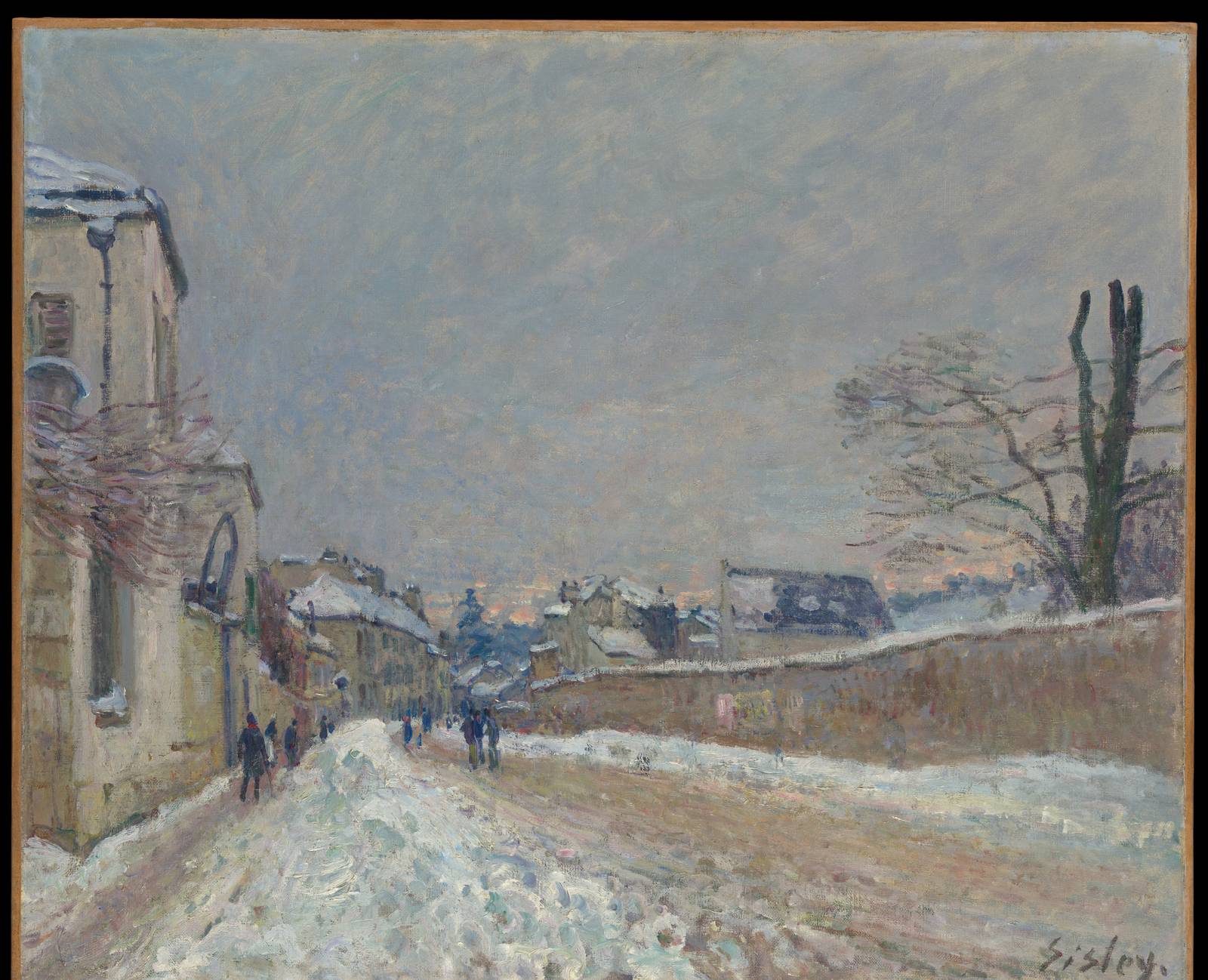
Background: Alfred Sisley, “Rue Eugène Moussoir at Moret: Winter”, 1891. The Metropolitan Museum of Art (public domain)